
Request a Quote
certificate
Leave Your Message

China Top Steel Hole Saw Manufacturers for Global Buyers?

China has become a major sourcing hub for cutting tools, including the Steel Hole Saw. Global buyers often compare Chinese manufacturers for pricing, production capacity, customization, and export experience. However, choosing a reliable supplier requires more than reviewing a polished website. Product consistency matters on the jobsite.

This guide examines Chinese Steel Hole Saw manufacturers from a practical purchasing perspective. It considers tooth design, steel grade, cutting diameter, shank compatibility, pilot drills, packaging, and available coatings. Real performance can be seen in clean cuts through mild steel, stainless steel, aluminum, and other common materials. A dependable manufacturer should explain these limits clearly. It should also provide samples, inspection records, test data, and responsive technical support.

Look beyond the catalog.

Factory audits, production videos, and customer references can reveal useful details. Buyers should verify tolerances, batch control, delivery terms, and after-sales procedures before placing larger orders. Certifications may support credibility, but they do not replace independent testing. A supplier can look impressive on paper and still deliver uneven teeth or poor weld strength. That risk deserves attention.

The manufacturers discussed here are assessed using practical and transparent criteria. These include manufacturing experience, engineering capability, quality systems, export reliability, and communication quality. Some supplier information may change over time, so buyers should confirm current specifications directly. Careful comparison often prevents costly rework, delayed shipments, and damaged trust. The right partner is not always the cheapest one. It is the manufacturer that consistently matches the tool to the application.
China Top Steel Hole Saw Manufacturers for Global Buyers?

What Defines a Top Steel Hole Saw Manufacturer in China?

A top steel hole saw manufacturer is defined by controlled performance, not attractive catalog photographs. Its engineers should understand cutting speed, tooth pitch, arbor fit, and heat produced during drilling. They select suitable high-speed steel or bi-metal construction for the material being cut. That choice affects edge life, chip removal, and operator safety. Real experience shows in practical details. A sample should cut clean holes through mild steel without excessive vibration.

Quality control must continue beyond the first sample. Reliable factories inspect tooth setting, outside diameter, weld strength, and surface finish during production. They should record batch numbers and keep inspection results available for review. This traceability helps buyers investigate inconsistent cutting results. Clear dimensional tolerances also matter, especially when hole saws must fit existing arbors and power tools. Small flaws matter.

For global buyers, a capable Chinese manufacturer communicates precisely about materials, packaging, lead times, and replacement policies. Technical staff should answer questions with measured data instead of vague promises. They may provide cutting trials for stainless steel, aluminum, or construction steel. However, no factory is perfect, and even strong suppliers can experience batch variation or delayed feedback. Buyers should test samples under real working conditions before placing large orders. A thoughtful supplier accepts this process and improves when test results reveal weaknesses.
What Defines a Top Steel Hole Saw Manufacturer in China?

This buyer-focused benchmark uses a 100-point evaluation model based on practical procurement criteria for steel hole saws. It is an industry reference framework, not a ranking of individual companies or brands.

Cutting performance and dimensional consistency receive the highest weighting because tooth durability, hole accuracy, and repeatable production directly affect drilling efficiency. Material traceability, quality control, customization, delivery capability, and compliance are also important when selecting a reliable global supplier.

Key Manufacturing Processes and Quality Standards

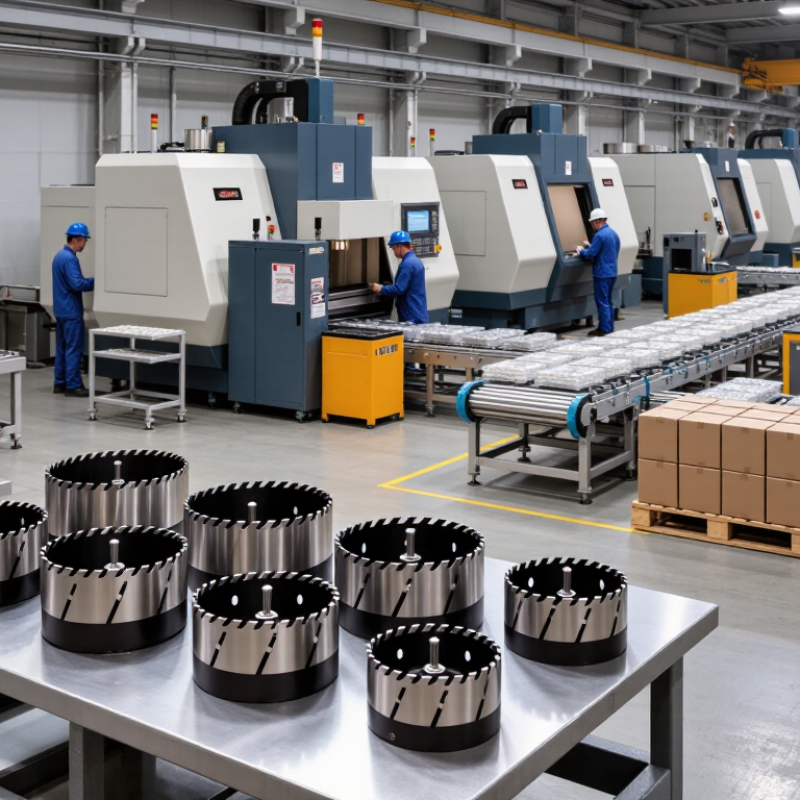
China’s steel hole saw production combines precision forming, heat treatment, and controlled tooth setting. Manufacturers commonly start with bi-metal strip or high-speed tool steel. Laser cutting or stamping shapes the cup, while welding joins the cutting edge to the body. CNC turning then controls diameter, arbor fit, and concentricity.

Heat treatment is critical. It must balance tooth hardness with body flexibility. Rockwell testing under ASTM E18 can verify hardness consistency across sampled teeth. ISO 4957 also provides useful requirements for tool steels. However, hardness alone is not enough. Excessive hardness may improve cutting life but increase tooth fracture during interrupted drilling. That trade-off deserves practical testing.

Quality control should follow documented systems, including ISO 9001 procedures, traceability, and batch inspection. The ISO Survey reports more than one million ISO 9001 certificates worldwide, showing the standard’s broad use. Certification helps, but it does not replace product evidence. Buyers should request cutting tests in mild steel, stainless steel, and tubing. Record hole count, cutting time, tooth damage, and burr condition. Small details matter.

The World Steel Association reported about 1.88 billion tonnes of crude steel production in 2023. That enormous material base does not guarantee consistent saw performance. Some suppliers still rely too heavily on visual inspection. It is convenient, but incomplete. A stronger audit checks material certificates, weld strength, runout, packaging protection, and random samples from finished batches. Real production data is often more revealing than polished claims.

China Top Steel Hole Saw Manufacturers for Global Buyers? - Key Manufacturing Processes and Quality Standards

Evaluation Dimension Manufacturing Process or Quality Requirement Typical Industry Data or Acceptance Reference Why It Matters to Global Buyers
Product Construction Bi-metal hole saws commonly combine a high-speed steel cutting edge with a tougher alloy-steel body. Carbide-grit and carbide-tipped designs are used for abrasive or difficult materials. Common product categories include bi-metal HSS, carbide-grit, and carbide-tipped hole saws. The selected construction should match the workpiece and cutting duty. The construction affects cutting life, impact resistance, heat tolerance, and suitability for wood, plastics, mild steel, stainless steel, masonry, or composites.
Raw Material Verification Incoming steel, HSS strip, carbide particles, arbor components, and packaging materials are checked against purchase specifications and supplier documentation. Typical controls include material certificates, grade verification, dimensional checks, and traceability by heat, batch, or production lot. Verified inputs reduce variation in tooth hardness, weld integrity, wear resistance, and finished-product dimensions.
Tooth Forming Teeth may be milled, ground, or formed before heat treatment. Variable-pitch tooth patterns are used on many bi-metal designs to reduce vibration and improve chip removal. Tooth pitch and geometry should be consistent around the complete cutting circumference, with no visibly damaged, missing, or uneven teeth. Consistent tooth geometry supports smoother cutting, lower vibration, improved hole quality, and more predictable tool life.
Welding or Joining For bi-metal products, the cutting edge is joined to the backing material by a controlled welding process, followed by inspection and finishing. The joint should be continuous and free from visible cracks, incomplete bonding, excessive flash, or separation after the specified functional test. Joint quality is critical because delamination can cause tooth loss, unsafe operation, and premature failure.
Heat Treatment Cutting sections may undergo hardening and tempering, while the backing section is controlled for toughness and dimensional stability. Hardness should be measured using a defined method such as Rockwell testing, with target values specified by the product design and material grade. The correct balance between hardness and toughness helps prevent rapid dulling, tooth chipping, cracking, and distortion.
Grinding and Finishing Final grinding removes burrs, refines tooth edges, controls the cutting diameter, and prepares the surface for corrosion protection or coating. Key checks include outside diameter, roundness, tooth height, body concentricity, arbor fit, and visual surface condition. Dimensional accuracy directly affects hole size, tool balance, runout, installation compatibility, and operator safety.
Arbor and Pilot Drill Compatibility Arbors, pilot drills, adapters, and locking components are machined and assembled to match the specified hole saw interface. Verification should cover thread or mounting compatibility, pilot-drill projection, fit, tightening, and resistance to loosening during use. Poor compatibility can create excessive runout, slipping, difficult installation, or damage to the power tool.
Dimensional Inspection Finished products are checked using calibrated gauges, calipers, micrometers, plug gauges, or coordinate measurement equipment where appropriate. Inspection plans should define nominal diameter, tolerance, body height, arbor dimensions, tooth pitch, and allowable runout. Documented dimensional control helps maintain interchangeability across batches and simplifies incoming inspection.
Runout and Balance The assembled hole saw is checked for concentricity and radial runout between the cutting body, arbor, and pilot drill. A buyer should require a documented runout limit appropriate to the hole saw diameter, machine speed, and intended application. Low runout improves hole accuracy, reduces vibration, and lowers the risk of uneven tooth loading.
Cutting Performance Testing Representative samples are tested on specified workpieces using controlled speed, feed pressure, lubrication, and cutting depth. A valid test report should state the workpiece material, thickness, hole diameter, machine settings, number of holes, and observed wear or failure mode. Standardized tests make supplier comparisons more meaningful than unsupported claims about service life.
Corrosion Protection Products may receive oiling, plating, black oxide, paint, or another specified protective treatment, depending on design and market requirements. The purchase specification should define coating type, appearance, adhesion, packaging protection, and any applicable corrosion test method. Adequate protection preserves appearance and function during storage and ocean or cross-border transportation.
Sampling and Lot Acceptance Inspection sampling is defined by lot size, product risk, inspection level, and acceptable quality limit rather than by informal visual checking alone. ISO 2859-1 provides sampling procedures and tables for lot-by-lot inspection based on attribute characteristics. A written sampling plan creates a consistent basis for pre-shipment inspection and claims handling.
Quality Management System The manufacturer should control design changes, purchasing, production records, calibration, nonconforming products, corrective actions, and customer complaints. ISO 9001 is a widely recognized framework for quality-management-system requirements; certification status should be verified from current documentation. A functioning quality system improves traceability and reduces repeated defects across export orders.
Calibration and Measurement Control Measuring instruments are identified, protected, periodically calibrated, and checked for suitability before use. Calibration records should show instrument identification, calibration date, due date, reference standard, and result or status. Reliable measurement is essential for diameter, runout, hardness, and assembly checks.
Packaging and Export Documentation Hole saws are protected against moisture, impact, tooth damage, and movement. Carton labels should identify size, quantity, lot, and handling information. Recommended documents include packing list, commercial invoice, product specification, inspection report, and material or conformity records when contractually required. Correct packaging and documentation reduce transit damage, customs delays, and receiving errors.
Buyer Pre-Shipment Checklist Confirm product drawings, materials, tooth configuration, dimensions, performance test conditions, packaging, sampling plan, and approval requirements before mass production. The purchase contract should clearly distinguish mandatory requirements from optional preferences and define the remedy for nonconforming goods. Clear specifications prevent misunderstandings and make supplier qualification more objective.

Note: Acceptance limits should be agreed in the purchase specification according to hole saw size, material, application, and applicable customer or regulatory requirements.

Leading Chinese Steel Hole Saw Manufacturers by Product Strength

China’s steel hole saw manufacturers compete through product strength, not only low production cost. The World Steel Association reported 1,005 million tonnes of Chinese crude steel output in 2024. This large industrial base supports stable access to carbon steel, high-speed steel, and bimetal strip materials.

Leading manufacturers usually separate product lines by cutting duty. Bimetal hole saws suit installers cutting mild steel, aluminum, and stainless sheet. Carbide-grit models handle abrasive materials, such as cement board and cast composites. Experienced buyers should inspect tooth geometry, weld consistency, arbor fit, and runout. A 65 mm saw should cut cleanly without visible vibration. Small defects become obvious after repeated use.

The ISO 9001 quality framework emphasizes controlled processes, corrective action, and traceable records. However, certification alone does not prove cutting performance. Ask for batch inspection data, hardness results, tooth-setting tolerances, and sample-cut videos. The International Trade Centre’s trade statistics also show China remains a major global supplier of hand tools and interchangeable tool parts, supporting its export capacity. Still, some catalogs overstate durability. I would test three samples, not one. Check cutting time, tooth loss, and edge wear after real site use. Packaging matters too, because loose arbors can damage teeth during long-distance transport.

How Global Buyers Should Compare Suppliers and Certifications

China Top Steel Hole Saw Manufacturers for Global Buyers?

Global buyers should compare suppliers beyond catalog photos and quoted prices. Start with steel grade, tooth geometry, cutting diameter tolerance, and shank compatibility. Ask for recent batch records, not only a polished sample. A reliable manufacturer should explain how it controls hardness, weld quality, coating thickness, and runout during production. Check the basics.

Certifications need careful interpretation. ISO 9001 indicates a quality management system, but it does not guarantee excellent hole saw performance. Request the certificate number, issuing body, validity period, and certified production scope. For steel traceability, ask for material test certificates, such as EN 10204 3.1 documents where appropriate. Confirm that heat numbers match the delivered batch. A certificate alone proves little.

Compare test evidence under similar conditions. Review cutting life, burr formation, heat resistance, and performance in mild steel or stainless steel. Request videos, laboratory reports, and independent inspection options. Factory audits can reveal storage problems, worn tooling, or inconsistent packaging. These details matter during long-distance shipping. My cautious view is simple: low prices deserve more questions, not immediate rejection. Samples may perform well while mass production varies. Define acceptance limits before ordering, including dimensional tolerance, labeling, packaging, and replacement procedures. Keep written records of every technical promise.

Ordering, Inspection, Shipping, and After-Sales Considerations

Choosing a steel hole saw manufacturer in China requires more than comparing prices. Ask about steel grade, tooth geometry, arbor compatibility, and production capacity. For demanding work, request samples in the exact diameter and material you will use. Confirm tolerances, packaging, lead time, payment terms, and export documents in writing. A clear purchase order prevents expensive misunderstandings.

Inspection should cover tooth spacing, weld quality, surface finish, runout, and actual cutting performance. Use photos, measurement records, and sample videos, but do not rely on images alone. A third-party inspection can verify quantity and specifications before shipment. Check cartons for moisture protection, barcode accuracy, and strong internal padding. Shipping details matter too. Confirm the loading port, freight responsibility, insurance, and destination customs requirements. One overlooked document can delay a container for days.

Tips: Keep one approved sample for comparison. Record batch numbers. Request a pre-shipment report. During after-sales discussions, define response time, replacement rules, and evidence requirements for damaged or poorly performing tools. A practical supplier should review cutting conditions, not simply blame the operator. In my experience, many disputes begin with unclear steel grades or unsuitable saw speeds. No checklist is perfect. Leave room for correction, especially after the first trial order.